The Dog as a Mirror
“A brilliant invention”
Dogs are not defined by thought, as we humans often are.
They do not live through narratives, projections of the future or carefully constructed facades, but through direct presence.
Pre-mind, you might say.
That makes dogs incredibly rich teachers.
They live in surrender, in the moment.
Not concerned with how they come across or trapped in who they were yesterday.
It is precisely for this reason that dogs are such pure mirrors of consciousness.
They reflect something that we as humans sometimes seem to lose so easily: being pure.
This pure, innocent and ever-so-unbridled enthusiastic behaviour consistently triggers my own enthusiasm and fascination.
Sometimes I think:
´if only you could see it´
What a brilliant invention.
Mirror function
At the same time, it also raises questions for me. Something feels a bit off.
A clear mirror can reveal something that is confrontational.
Despite everything dogs can teach us about presence, connection and trust, you still see every day how animals are mistreated, controlled or misunderstood.
What does the way we treat animals actually say about our own inner world?
Story vs reality
When I visit people’s homes, I always take a moment to look at the dog. It often gives me an indication of the ‘atmosphere’ in the house.
People often tell the story. Dogs show the reality.
They reveal what lies beneath the words.
An uninhibited dog often reflects an uninhibited part of its owner. It is not uncommon to see shy dogs with people who are themselves cautious in their interactions.
This is not meant to be judgemental, but these are examples of resonance.
And of course, breed, history, trauma, training and health all play a part in a dog’s behaviour.
But don’t underestimate resonance.
Dogs react less to our words and more to our nervous system.
A dog that is constantly alert, reacts quickly, scans its surroundings frequently and finds it difficult to relax can provide a great deal of information about its environment. There is a good chance that this is an environment where tension or unpredictability is palpable.
When a dog has few boundaries, this can easily resonate with an environment where structure is diffuse. Or a dog that is excessively inhibited can be an example of control or caution within the system.
And a stable, relaxed dog?
You often sense more stability, clarity or emotional consistency in the home as well.
It’s actually as if not only the dog becomes visible, but the system surrounding it.
The line between control and trust
I see it on the street too.
How much love people can feel for their dog, but at the same time how much tension.
“What if he runs away?”
“What if it goes wrong?”
Of course, setting boundaries is important. The same goes for safety.
But strikingly often, it feels as though it’s not just the dog on the lead…
but our own fear too.
As if, through control, we’re trying to prevent what we find hard to bear deep down.
The lead tight.
Literally and figuratively.
Perhaps dogs are mirroring the following back to us here:
How much space do we actually give to life, spontaneity and trust…
without immediately wanting to control everything?
Dias: co-regulation in practice
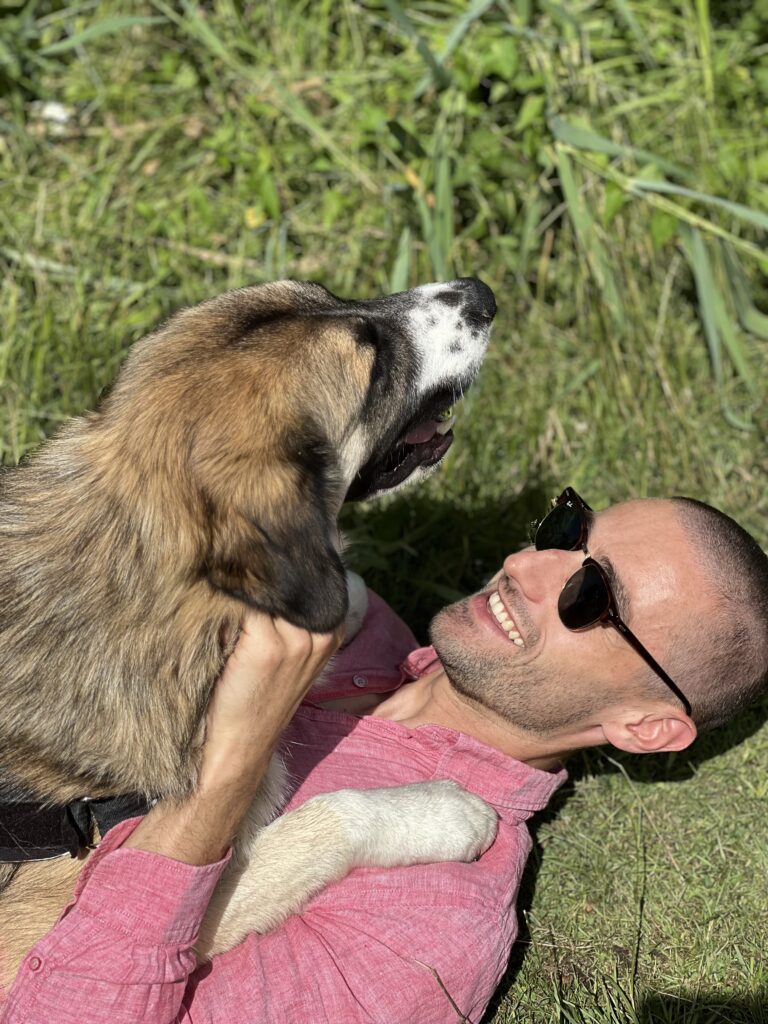
My own dog, Dias, teaches me a great deal about this.
I know very little of his past, but it seems clear that he has known danger.
His body bears the marks of survival.
Life on the streets in the mountains of Greece.
A bullet in his back.
The other three dogs from the village have since been poisoned and have died…
And yet…
His core has remained remarkably open. Playful, gentle and very open to contact with people and other dogs. At the day care centre, he is ‘deployed’ to regulate other dogs. Especially when new dogs arrive there.
That is interesting. A secure attachment must surely have formed there in the first weeks or months. Together, we are exploring something that is essential to me:
How can security deepen through (co)regulation?
Together, in connection, we create and deepen a foundation of trust.
With freedom, attunement and joy as the underlying philosophy.
When fireworks go off, I sometimes still see old tension flare up.
Fear, alertness. A body that may be remembering something.
In any case, the nervous system perceives a danger it doesn’t seem able to pinpoint. This is interpreted as confusing and threatening.
Where he initially sought immediate shelter, I now see more and more often:
fear… regulation… recovery.
His system is learning.
Not because we are resolving his past,
but because connection makes new experiences possible.
It is interesting to look further into the extent to which impactful / traumatic events can be processed in dogs. Fundamentally, by staying present with them, offering safety, giving them space, observing, and having an underlying (basic) understanding of how they function.
Mirrors of Consciousness
You might ask yourself,
are we looking merely at ‘a dog’, or are we looking at elements such as:
Trust, tension, control,
love and presence?
And thus… at ourselves.
Your dog does not merely walk beside you.
He also points – in his own quiet way – inwards.
Towards how you connect, set boundaries, feel, and are present.
Without words and without judgement.
An unfiltered mirror.
And a reminder of pure being ✨
Reflection question
If your dog (or an animal you know) were to mirror something about your state of being, what do you think he would show you and what does that evoke in you?