Psychosomatics & Psychosomatic complaints
'A field that cannot easily be defined'
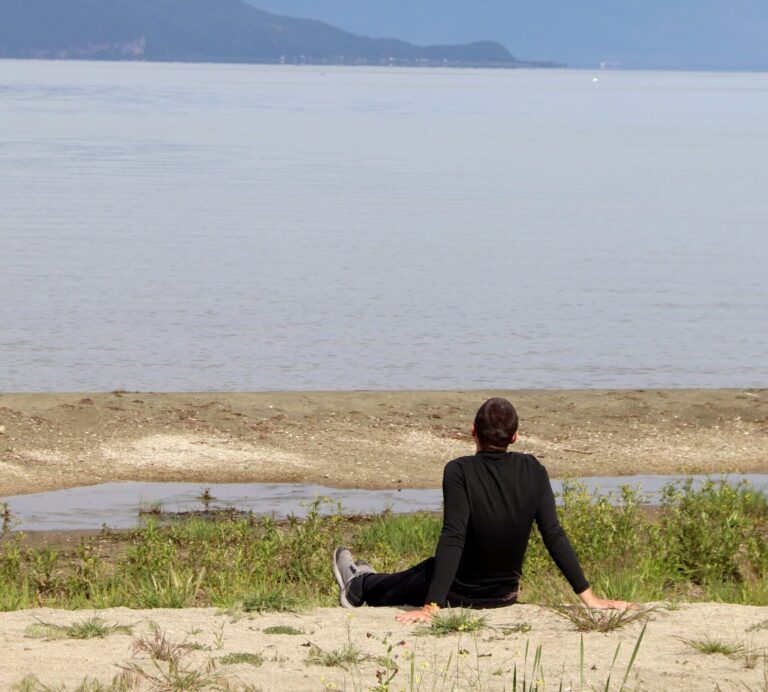
Is it a coincidence that this is a theme for which it is difficult to find a suitable image?
Or does that say something about how we, as humans, tend to want to grasp what cannot be immediately captured?
Psychosomatics is not a clearly defined field.
It's in motion.
Between body, psyche and consciousness.
Experience and meaning.
Between what can be felt and what cannot (yet) be understood.
And for me, this raises a fundamental question:
how far does our capacity for interpretation extend – and is it really helpful to want to ‘exploit’ it to the full?
Within therapy, there is a tension here. On the one hand, there is a tendency to explain, to organise, to provide direction. On the other hand, the work actually calls for restraint (!)
As a therapist, you want to avoid filling in the blanks, steering, and projecting.
It is a true art not to get “in the way” of your client’s process.
Interpreting too early can fix something that is still in motion.
But a complete lack of direction can also feel unsafe or confusing.
It therefore requires precision. And timing.
Today I will discuss how symptoms can manifest themselves, what underlying factors may be at play, and how we work with these within therapy.
Ambiguity
Psychosomatic symptoms are a source of confusion for many people. The symptoms are physically palpable, sometimes very intense, but medically speaking, there is often no (or insufficient) explanation to be found.
This quickly leads to the idea that it’s “all in the head.” A phrase that often does the experience a disservice. Not because it’s incorrect that the psyche and body are connected, but because for some it suggests that it might be less real. Less physical.
While the opposite is often the case.
One coherent system
For me, psychosomatics is about the interconnection between body, psyche and consciousness.
Not as separate parts, but as one coherent system. The body constantly reacts to what we experience, what we feel, and what we—consciously or unconsciously—carry with us.
This largely happens outside of our conscious thought.
Experiences that are too intense, too early, or too complex to fully process do not disappear. They remain present somewhere within the system. Sometimes silent, sometimes in the background. And at other times so emphatic that they make themselves heard through the body.
Not always as a message that is immediately clear.
Rather, for example, as tension or pain, linked to a recurring narrative.
Conversely, when something goes unseen or unheard (for a long time), the body seeks another outlet.
Symptoms
This can manifest, for example, as:
Chronic pain, fatigue, long-lasting physical symptoms, breathing difficulties, tension-related symptoms, or gastrointestinal issues.
These are still somewhat “umbrella terms.” In therapy, we can look more deeply and thus more layeredly at what is underlying. In my experience, there are many more ways in which the body can make itself heard.
In practice, for example, I regularly see complaints of dizziness, (a tendency to) faint, or tinnitus. Of course, there may be an underlying medical cause, and it is important that this be investigated as well. It is striking, however, that these types of symptoms often seem to be accompanied by high levels of stress, tension, and/or unresolved emotional issues.
The body as a gateway
The question is how we interpret the body’s signals. These can be viewed as ‘defects’, but also as entry points. A place where something may become visible that previously could not show itself. Where signals have often been ignored or suppressed, they actually call for attention.
That is a bit of a counterintuitive shift.
That does not mean that symptoms are immediately “logical” or unambiguous.
On the contrary.
In practice, signals are often layered and sometimes contradictory.
There may be a simultaneous need for movement and for stillness.
For closeness and for distance.
Not as a simple cause-and-effect relationship, but as part of a complex whole.
Fortunately, in therapy, we don’t need to understand the complex whole to be able to work with it. We work precisely with what presents itself in the moment—a tension, a survival mechanism, or an underlying feeling, for example.
My approach within psychosomatics
I work from:
- body-oriented observation
- alignment with the nervous system
- slowing down rather than forcing
- following / remaining present with what arises
The process does not unfold according to a fixed protocol. Every complaint, every body, and every story requires its own approach. In fact, there is an invitation to take the body’s intelligence seriously once again.
By slowing down and listening to it. From there, movement can arise.
Healing occurs by remaining inwardly present with what arises, without resistance.
Therapeutic support can help you on this journey. Everyone has blind spots, and it can be helpful to bring these to light with the help of a therapist.
Reminder
In addition, an inward-looking, exploratory approach helps to alleviate symptoms and break free from burdensome patterns.
In the second blog post:
‘Experiencing and the process of becoming aware’
I have explored in more depth the steps you can take (in part) on your own .
Next week, the third part of this four-part series is on the agenda:
“Nature as a Sacred Place”
Here, the focus shifts to a different angle:
the role of nature 🌿 in recovery and regulation.
To be continued…!